
How to Choose Traffic Signs for Parking Lots and Private Roadways
Most drivers never think about the signs in a parking lot — until one is missing. A delivery truck rolls through an unmarked exit lane, a visitor misses the one-way arrow and turns into oncoming traffic, or a pedestrian steps into a driving aisle with no crosswalk warning. On private facilities, the property owner or manager is usually the one responsible for keeping circulation safe and predictable. Choosing the right traffic signs is one of the most cost-effective ways to do that.
This guide walks through a practical selection process: understanding what the national standard covers, reading the shape-and-color language drivers already know, sizing and material choices, and placement principles that work on real sites.
What the MUTCD Covers — and Why It Matters for Private Sites
In the United States, the Manual on Uniform Traffic Control Devices (MUTCD), published by the Federal Highway Administration, defines the national standards for traffic control devices. It applies to "all streets, highways, pedestrian and bicycle facilities, and site roadways open to public travel." The current edition is the 11th Edition (adopted December 2023, effective January 2024), with Revision 1 effective March 2026.
What does that mean for a shopping center, warehouse yard, school campus, or HOA? Even where a local ordinance does not explicitly require MUTCD compliance on private property, following MUTCD sign designs is widely treated as best practice: drivers already read that visual language, and consistency reduces confusion. Always confirm requirements with your local authority having jurisdiction (AHJ) — some municipalities do extend sign standards to private developments through site-plan or permitting conditions.
Reading the Shape-and-Color Language
One of the MUTCD's strengths is that shape and color carry meaning before a driver reads a single word. When selecting signs, match the message to the correct family:
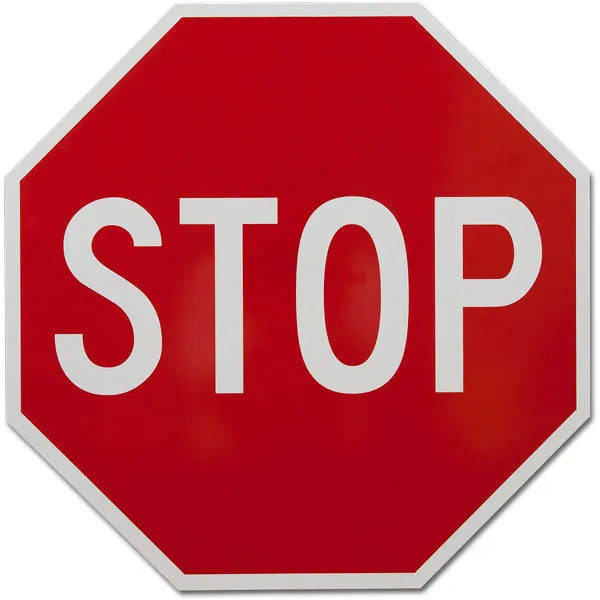
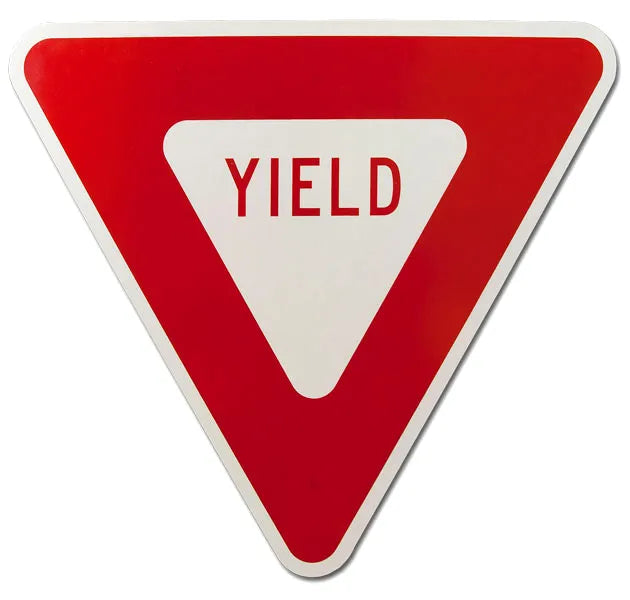
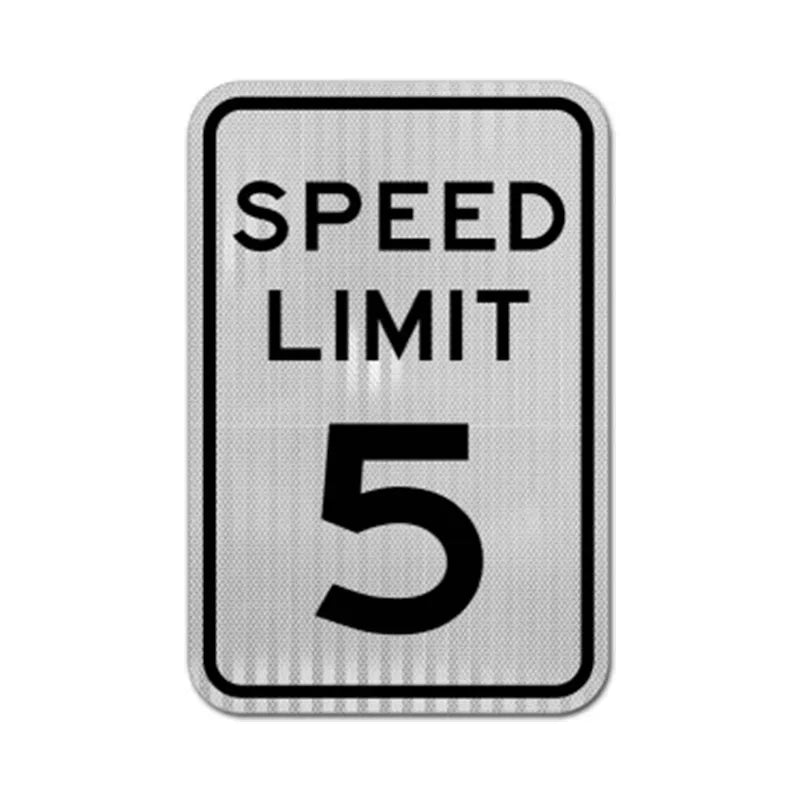
- Regulatory signs — the rules. These tell drivers what they must or must not do. The STOP sign (R1-1) is the only octagonal sign in the system: red background, white border, white STOP legend. The YIELD sign (R1-2) is an inverted triangle in red and white. Speed Limit signs (R2-1) are rectangular with black legend on white. Related regulatory signs include DO NOT ENTER (R5-1), ONE WAY (R6-1/R6-2), turn prohibitions, and KEEP RIGHT (R4-7).
- Warning signs — the heads-up. These alert drivers to conditions ahead, such as pedestrian crossings, speed bumps, or children at play. They typically use a diamond shape with black symbols or legends on a yellow or fluorescent yellow-green background.
Because this language is standardized nationally, a driver from any state recognizes a stop or yield sign instantly. That is the main argument for sticking to standard designs rather than custom graphics on private sites.
A Four-Step Selection Method
Step 1 — Walk the site and map conflict points. Start with a site plan or a simple walk-through during a busy period. Mark every place where vehicle paths cross, merge, or meet pedestrians: main entrances and exits, intersections of driving aisles, loading dock approaches, crosswalks, and gates.
Step 2 — Assign one clear message per location. Each conflict point usually needs just one primary instruction. Uncontrolled exits get STOP signs; low-volume merges get YIELD; driving aisles get posted speed limits; pedestrian crossings get advance warning. Resist the urge to stack multiple messages on one post — a single, legible instruction beats a cluttered one.
Step 3 — Size for viewing distance. A sign that is too small is the same as no sign. MUTCD standard sizes scale with road type and speed: for example, the standard STOP sign (R1-1) is 30 × 30 inches for conventional roads with a 24 × 24 inch minimum, and the standard Speed Limit sign (R2-1) is 24 × 30 inches (FHWA regulatory sign size tables). On low-speed private sites, the minimum sizes are a reasonable starting point, sized up where approach speeds or sight lines demand it.
Step 4 — Choose materials for day-and-night performance. A sign has to work at midnight in the rain, not just at noon. Look for prismatic reflective sheeting that returns headlight illumination to the driver — OranLite's signs use High-Intensity Prismatic (HIP) reflective sheeting for long-distance visibility. For the sign blank itself, match the material to the installation: 0.080" aluminum is rigid and suited to permanent outdoor mounting, while 0.120" ABS plastic is lightweight, impact-resistant, and non-corrosive, which fits temporary zones or weight-sensitive applications.
Placement Principles That Work
Even the right sign fails if drivers cannot see it in time. A few field-tested principles:
- Place regulatory signs where the action is required. A STOP sign belongs at the stop line or the point where the driver must stop — not fifty feet earlier.
- Give warning signs advance distance. Warning signs (pedestrian crossing, speed bump ahead) need to appear early enough for a driver to react at the posted speed.
- Keep the face visible. Mount signs at a height and angle clearly visible to approaching drivers, and trim vegetation or relocate equipment that blocks the view. Re-check visibility at night, when headlight angles change what a driver sees.
- One message, one post. Avoid mounting competing signs on the same post where they dilute each other.
Who This Guide Is For
Facility and property managers responsible for parking lots and campuses; HOA boards setting circulation rules for private streets; schools and daycare centers managing drop-off and pick-up traffic; warehouse and distribution operators controlling truck and forklift interaction zones; and contractors refreshing signage during site improvements.
Signs Worth Stocking for a Typical Site
Most private facilities can cover the majority of their needs with a short list:
- Reflective Stop Signs — for exits, aisle intersections, and dock approaches
- Reflective Yield Signs — for low-volume merges and roundabout-style entries
- Reflective Speed Limit Signs — for driving aisles, typically 5–15 mph on private sites
- Do Not Enter / Exit Only Signs — for one-way exits and dock doors
- One Way Signs and Keep Right Signs — for circulation control in aisles and around islands
- Children Crossing Warning Signs — for schools, parks, and residential streets
Good signage is a small investment against the cost of a single incident. Walk your site, map the conflict points, and match each one with a standard sign drivers already understand. Browse OranLite's reflective traffic signs or contact us for volume pricing on multi-site rollouts.